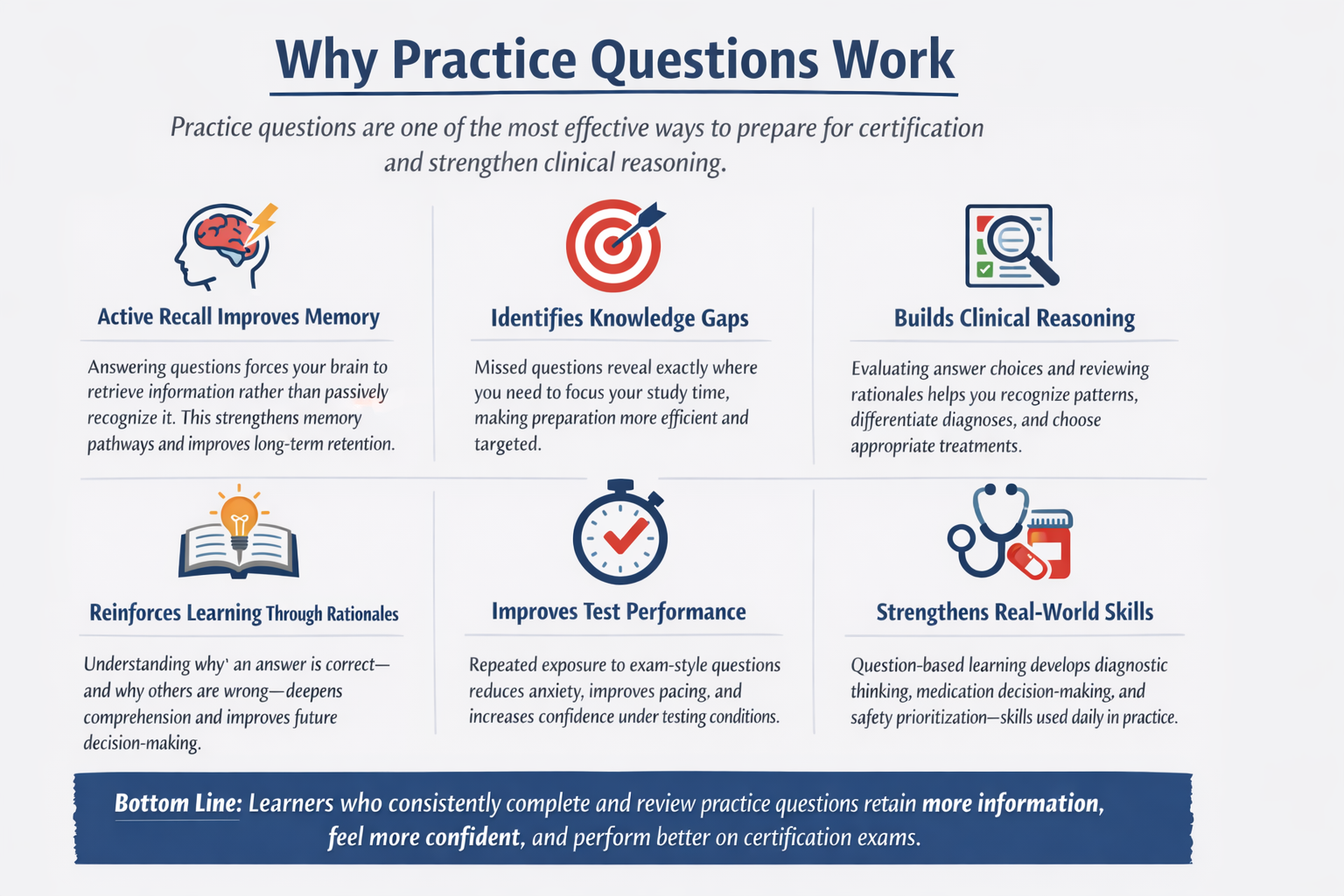
Whether you are preparing for the NCLEX, advancing your nursing degree, studying for certification, or strengthening clinical knowledge in practice, one strategy consistently stands out as highly effective: practice questions.
Many learners spend hours rereading notes, highlighting textbooks, or reviewing slides. While these methods can feel productive, they are not the most efficient way to build lasting knowledge or clinical reasoning. Practice questions actively engage your brain, helping you retain information longer and apply it more effectively in both testing and real patient care.
1. Practice Questions Strengthen Long-Term Memory
Answering questions requires your brain to retrieve information, not just recognize it. This process—called active recall or retrieval practice—has been shown in learning science research to improve long-term retention more than passive review methods alone.
When you:
Read a question
Commit to an answer
Review the rationale
You reinforce memory pathways. Over time, this makes recall faster and more accurate when you need it most—during exams or clinical decision-making.
Passive studying builds familiarity.
Active recall builds competence.
2. They Build Clinical Reasoning — the Core of Nursing Practice
Nursing exams do not only test knowledge; they test judgment. Practice questions help you develop the ability to:
Recognize patient patterns
Prioritize interventions
Identify safety risks
Apply pathophysiology to symptoms
Choose appropriate treatments
Determine the next best action
This mirrors real clinical situations where nurses must make rapid, informed decisions.
Practice questions train your brain to think like a nurse, not just memorize content.
3. Practice Questions Reveal Knowledge Gaps
One of the biggest challenges in studying is knowing what you do not know. Practice questions quickly identify areas that need improvement.
For example, you may discover:
Medication safety gaps
Weak understanding of disease processes
Difficulty with prioritization questions
Confusion about assessment findings
Uncertainty with pharmacology or lab interpretation
Once identified, you can focus your study time more efficiently instead of reviewing everything equally.
Targeted study reduces overwhelm and improves confidence.
4. Rationales Deepen Understanding
The most valuable learning often happens after answering the question.
High-quality rationales:
Explain why the correct answer is right
Clarify why other options are incorrect
Connect concepts to clinical scenarios
Reinforce safety principles
Highlight key exam points
Understanding reasoning—not just the answer—helps you apply knowledge across multiple patient situations.
5. They Reduce Test Anxiety and Improve Time Management
Repeated exposure to exam-style questions helps you become comfortable with:
Question wording
Testing format
Pacing under time pressure
Decision-making with limited information
This familiarity reduces anxiety and increases confidence on exam day.
Longer practice exams also build mental stamina, which is essential for success on major nursing exams.
6. Practice Questions Strengthen Real-World Nursing Skills
The benefits extend beyond testing.
Question-based learning improves:
Clinical judgment
Patient safety awareness
Medication decision-making
Assessment interpretation
Prioritization and delegation
Critical thinking
These are the same skills nurses use every day in practice.
7. Consistency Matters More Than Perfection
You do not need to get every question right to improve. Growth happens when you:
Attempt questions seriously
Commit to an answer
Review rationales carefully
Identify weak areas
Revisit challenging topics
Over time, accuracy improves naturally.
Final Takeaway
Practice questions are one of the most effective tools for nursing learners at any stage—from students to experienced clinicians.
They:
Improve retention
Strengthen clinical reasoning
Build confidence
Identify gaps
Prepare you for exams
Enhance patient care skills
Consistent, thoughtful practice transforms knowledge into competence — and competence into confidence.